Elmer Foster Montgomery: The Marine Behind the Name
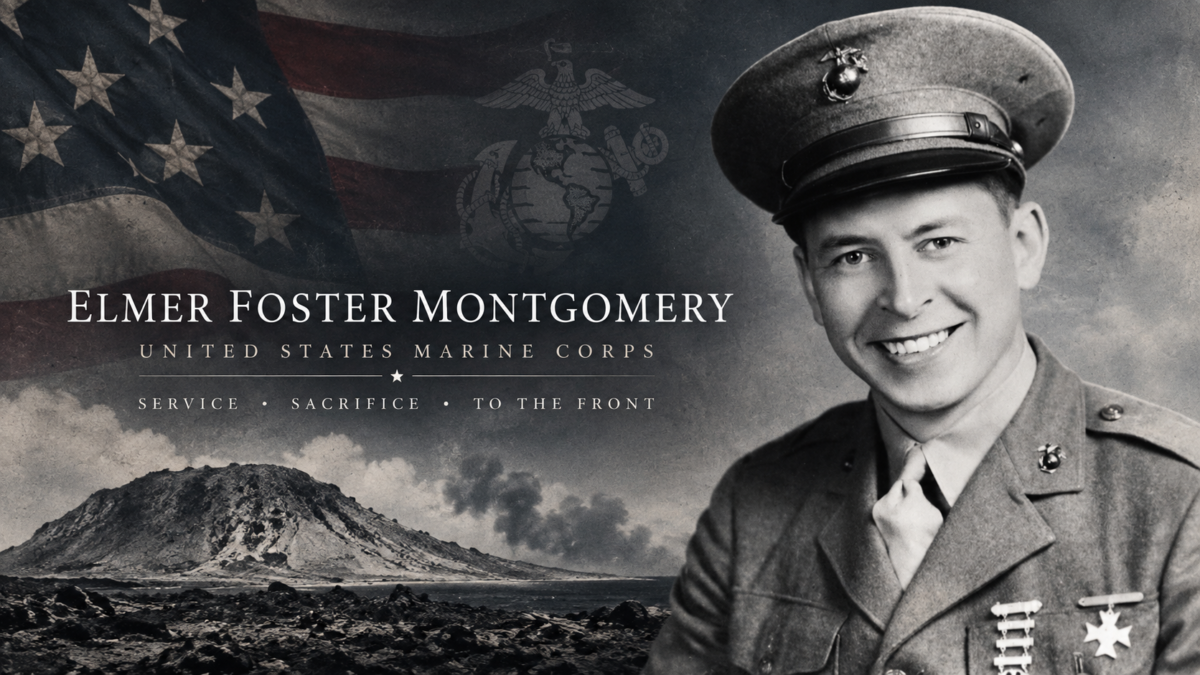
For sailors who served aboard USS Elmer Montgomery (DE-1082/FF-1082), the ship’s name belonged to a Marine whose life ended more than 25 years before the vessel entered service.
Sergeant Elmer Foster Montgomery did not spend most of his Marine Corps career on the front line. His administrative skills made him valuable as a clerk and stenographer. On Iwo Jima in March 1945, however, Montgomery asked to leave headquarters duty and join Marines fighting at the front.
He never returned.
His actions on March 11, 1945, earned him a posthumous Navy Cross. More than two decades later, the United States Navy named a warship in his honor.
From Montana to the Marine Corps
Elmer Foster Montgomery was born on April 3, 1913, in Kalispell, Montana. He graduated from Kalispell High School in 1930.
Montgomery attended Montana State University for about a year. He later studied at Wilson’s Modern Business College in Seattle in 1934. Published naval records also document his service in the Montana National Guard from 1928 to 1931.
Before joining the Marine Corps, Montgomery worked several civilian jobs. His business and administrative education later proved useful in his military assignments.
His Montana background also became relevant on Iwo Jima.
Brigadier General James D. Hittle later recalled that Montgomery had experience hunting in the mountains. When front-line units needed replacements, Montgomery believed that experience could help him in combat.
He also told Hittle that he wanted to help the younger Marines already fighting there.
Montgomery enlisted in the United States Marine Corps Reserve on November 10, 1942. The Marine Corps photographed him on November 17, only one week after his enlistment.
He completed recruit training at San Diego. After training, the Corps assigned him to Headquarters and Service Company, School Battalion, at Camp Elliott, California.
On September 16, 1943, Montgomery joined Company D, 1st Armored Amphibious Tractor Battalion, Fleet Marine Force.
His wartime service soon carried him across the Pacific.
Service Across the Pacific
Montgomery served in areas associated with the Marshall Islands and the Marianas. In May 1944, he joined Headquarters Company, 3rd Marine Division.
His main duties involved administration.
That part of his service matters because Montgomery was not primarily a front-line rifleman.
James D. Hittle served as the 3rd Marine Division’s G-4, or logistics officer. He met Montgomery on Guam when his headquarters section needed a clerk-typist.
Hittle later described Montgomery as highly capable at the job. He could type, take shorthand, handle administrative procedures, and help keep the office organized.
Hittle also remembered him as quiet and well liked.
His recollections provide several glimpses of Montgomery away from official military paperwork. Montgomery carried a small Bible with a white leather cover in his fatigues. During breaks, he sometimes took it out and read.
Hittle and Montgomery also discovered that they shared an interest in The Rubáiyát of Omar Khayyám.
These details help preserve a picture of Montgomery beyond his military record. They describe the man his fellow Marines knew before Iwo Jima.
The Battle for Iwo Jima
American forces landed on Iwo Jima on February 19, 1945. The 3rd Marine Division joined the battle as fighting continued across the island.
Japanese defenders used caves, tunnels, fortified positions, machine guns, mortars, and artillery to resist the American advance. The fighting produced heavy casualties.
Montgomery initially remained with division headquarters.
As losses increased, front-line units needed replacements. The division began drawing additional Marines from support and headquarters sections.
Hittle later recalled that Montgomery was not among those initially chosen for front-line duty.
Montgomery asked to go anyway.
Hittle told him that the division had not selected him. Montgomery continued to press his case.
He explained that his experience as an outdoorsman and hunter might make him useful. He also wanted to help the younger Marines already fighting at the front.
Hittle eventually approved the request.
He never saw Montgomery alive again.
Joining the 9th Marines
By March 11, Montgomery was serving as a rifleman with a platoon from Company C, 1st Battalion, 9th Marines, 3rd Marine Division.
The platoon moved beyond the established front and encountered a strongly defended Japanese position.
Enemy fire trapped the Marines in exposed terrain. Machine-gun fire made withdrawal dangerous, while mortar fire threatened anyone who remained in place.
Hittle later learned more about the engagement from a wounded Marine who survived it.
According to that account, the platoon had moved into a shallow depression. A concealed Japanese machine gun then opened fire.
Mortar rounds also began falling nearby.
The Marines needed to leave the position, but the machine gun covered their likely withdrawal route.
Montgomery acted.
March 11, 1945
Montgomery decided to draw the enemy’s attention away from the other Marines.
His Navy Cross citation states that he advanced alone toward the fortified Japanese position while firing his rifle. The movement caused the enemy to shift its attention and fire toward him.
That gave the other Marines an opportunity to withdraw.
Hittle’s later account adds another detail. Montgomery reportedly told the men to move when he drew the enemy’s fire.
He then rose and advanced toward the machine-gun position.
The other Marines escaped the exposed area.
Montgomery did not.
Missing on Iwo Jima
The Marine Corps reported Montgomery missing in action on March 11, 1945.
Another Marine later reported seeing what appeared to be Montgomery’s body near the Japanese position. Heavy fighting prevented American forces from recovering it.
American artillery later struck the area.
Military authorities officially declared Montgomery dead on August 17, 1945.
His remains have never been identified.
After the war, the American Graves Registration Service searched Iwo Jima for missing U.S. personnel. A 1948 search failed to locate remains that investigators could associate with Montgomery.
The Defense POW/MIA Accounting Agency continues to list him as unaccounted for from World War II.
His name appears at the Courts of the Missing at the National Memorial Cemetery of the Pacific in Honolulu, Hawaii.
The Navy Cross
The Navy awarded Elmer Foster Montgomery the Navy Cross posthumously for his actions on March 11, 1945.
The Navy Cross ranks as the second-highest military decoration for valor available to members of the Navy and Marine Corps. Only the Medal of Honor ranks above it.
Commander in Chief, Pacific Forces issued Montgomery’s award under Serial 36921 on December 19, 1945.
The citation focuses on one specific act.
Montgomery advanced toward the Japanese position and drew enemy fire toward himself. His actions allowed the other members of his platoon to leave the exposed area.
The citation credits his decision with helping the trapped Marines reach safety.
That action forms the central reason for his Navy Cross. Montgomery deliberately exposed himself to enemy fire so that other Marines could withdraw.
Other World War II service decorations appear in some later summaries of Montgomery’s military career. Those awards should remain separate from the Navy Cross.
The Navy Cross directly recognized his actions on Iwo Jima.
James Hittle Remembers Montgomery
Much of what we know about Montgomery as a person comes from James D. Hittle.
Hittle eventually retired from the Marine Corps as a brigadier general. He later served as Assistant Secretary of the Navy for Manpower and Reserve Affairs.
Decades after Iwo Jima, Hittle continued to write and speak about the Marine who had worked for him on Guam.
His memories add context that an official citation cannot provide.
Montgomery handled routine headquarters work. He typed correspondence, took shorthand, dealt with administrative matters, and supported the division staff.
He read during quiet moments and carried a Bible. Fellow Marines knew him as a quiet and capable member of the headquarters section.
Nothing about those duties required him to leave headquarters for the front.
He chose to go.
That decision became one of the defining parts of his story.
When the 3rd Marine Division needed replacements, Montgomery volunteered to leave his administrative position and join a combat unit.
Within a short time, he was dead.
A Navy Ship Takes His Name
Hittle’s connection to Montgomery did not end with the war.
Years later, Hittle served as Assistant Secretary of the Navy. From that position, he helped bring Montgomery’s name forward for a new Navy escort ship.
The Navy approved the name USS Elmer Montgomery.
Avondale Shipyard in Louisiana launched the future DE-1082 on November 21, 1970. Montgomery’s sister, Mrs. Daniel Webster, sponsored the ship.
USS Elmer Montgomery entered commissioned service on October 30, 1971.
The Navy redesignated the ship FF-1082 in 1975. She remained in active service until June 30, 1993.
Hittle lived long enough to witness both ends of the ship’s service.
He took part in events connected with the ship during her construction. More than two decades later, he also spoke at her decommissioning.
That connection gives the naming of USS Elmer Montgomery unusual personal context.
An officer who knew Montgomery on Guam had approved his request to leave headquarters for the front. Hittle later learned how Montgomery died.
Years afterward, he helped ensure that the Navy preserved Montgomery’s name on a new warship.
The Marine Behind FF-1082
Elmer Foster Montgomery was 31 years old when he died on Iwo Jima.
His story did not begin with the combat action that earned the Navy Cross.
Before the war, he had served in the Montana National Guard, attended college, studied business, and worked civilian jobs.
In the Marine Corps, he became an administrator, stenographer, clerk, and member of a division headquarters staff. He performed the routine work that helped keep a large military organization functioning.
Then the fighting on Iwo Jima created a need for replacements.
Montgomery volunteered.
On March 11, 1945, enemy machine-gun and mortar fire trapped his fellow Marines. Montgomery moved toward the enemy position and deliberately drew its fire.
The others withdrew.
Montgomery never returned.
His Navy Cross citation preserved the official account of his final action. Hittle’s recollections preserved a more personal image of the man.
They describe a quiet Montana Marine who worked in a headquarters office, carried a small Bible, and volunteered to leave that office for the front.
More than 25 years later, his name went to sea aboard USS Elmer Montgomery.
For the sailors who later served aboard DE-1082 and FF-1082, the ship’s name connected their own service to a Marine who died on Iwo Jima on March 11, 1945.